A ten-minute film about type 2 diabetes, with every claim mapped to the official guidance it comes from.
Every claim in the film is tagged to one of the sources below. Nothing is invented, and
nothing is dosed or targeted: the film never gives a number to aim for, or a medicine
change to make. Five lines are still waiting for a clinician — they are listed here, not
hidden.
Low blood sugar is below 4 mmol/L, and happens to people on insulin or some other diabetes medicines.
Symptoms: hungry, dizzy, anxious or irritable, sweating, shaking, tingling lips, fast heartbeat, tiredness, blurred vision, confusion; severe cases can fit or become unconscious.
Treat with fast sugar — a small glass of fruit juice or sugary drink, or 5 glucose tablets — recheck after 10–15 minutes, repeat if still low, then eat a longer-acting carbohydrate.
Causes include gliclazide and glimepiride, missed or delayed meals, and a lot of exercise without eating more carbohydrate.
Do not skip or delay meals.
This page is past its own review date. Re-check before publishing widely. The content matches standard practice.
How we used it: Read for facts, rewritten.
S5 World Health Organization — Physical activity — fact sheet
No official page states a protein target for older adults, so this film gives no target and no number — only 'add one protein food to breakfast'.
Reducing protein when the kidneys are affected is standard clinical practice but is not stated in these sources, so the film only says: ask your doctor if your kidneys are affected.
5.36 — adults with type 2 diabetes: 150+ min/week of moderate-to-vigorous aerobic activity, spread over at least 3 days/week, with no more than 2 consecutive days without activity.
5.37 — 2–3 sessions/week of resistance exercise on nonconsecutive days.
5.38 — most older adults with diabetes: flexibility training and balance training 2–3 times/week.
5.34 — prolonged sitting should be interrupted at least every 30 min for blood glucose benefit.
Aerobic, resistance, flexibility, balance and leisure-time activity are each named as their own mode, with distinct benefits.
Anyone with a foot injury or open sore should be restricted to non-weight-bearing activity; people with peripheral neuropathy should wear proper footwear and examine their feet daily.
How we used it: Read for facts, rewritten. The numbers below are the ADA's own recommendations, cited by number.
S10 World Health Organization — WHO Guidelines on physical activity and sedentary behaviour (2020)
Adults aged 65+: at least 150–300 min/week moderate-intensity aerobic activity (or 75–150 min vigorous, or an equivalent mix).
65+: muscle-strengthening activities at moderate or greater intensity involving all major muscle groups, on 2 or more days a week.
65+: varied multicomponent activity emphasising functional balance and strength at moderate or greater intensity, on 3 or more days a week, to enhance functional capacity and prevent falls.
All adults should limit sedentary time; any amount of activity is better than none.
How we used it: Read for facts, rewritten. No WHO text or images copied.
S11 Buffey et al., Sports Medicine (2022) — Interrupting prolonged sitting with standing and light-intensity walking — systematic review and meta-analysis
Short, frequent light-intensity walking breaks (roughly 2–5 minutes every 20–30 minutes) lower the glucose rise after a meal compared with staying seated.
Light walking lowered postprandial glucose more than simply standing.
This is where the film's 'ten minutes after the main meal' and 'stand up every half hour' come from — moderate trial evidence, not a WHO/NHS rule.
How we used it: Read for facts, rewritten. Supports the 'walk after the meal' and 'move every half hour' lines.
The science behind it
Why each picture in the film is the picture it is, in plain language, with
the source for each answer.
What is the sugar the film keeps showing?
It is glucose, and most of it comes from the starchy and sweet parts of a meal — rice, roti, dal, fruit. It is not a poison: it is the fuel every cell runs on. The problem the film describes is not sugar existing, it is sugar staying in the blood instead of getting into the cells.
Why can insulin not do its job in type 2 diabetes?
Insulin is the signal that tells a cell to let glucose in — CDC's own wording is that it 'acts like a key'. In type 2 diabetes the cell stops responding properly to that signal. The medical name is insulin resistance, and it is why the film draws a key that turns in a lock that has gone stiff, rather than a missing key.
Because it compensates. When cells respond poorly, the pancreas makes more insulin to push the same amount of glucose in. It can keep that up for years. Over time it cannot keep up, and blood glucose starts to rise — which is when the diagnosis usually happens.
Why does the film spend so long on legs and muscle?
Skeletal muscle is the main place glucose goes after a meal, and working muscle takes it up without needing much insulin. That makes movement a second route into the cell, alongside the medicine. WHO's guidance is blunt: any activity is better than none, and muscle strengthening benefits everyone.
S5 the wording 'biggest place your sugar goes' is one of the five lines awaiting clinical review
Why would eating vegetables first change anything?
Because the same food, in a different order, reaches the blood at a different speed. Trials measuring glucose after meals show a lower and slower rise when carbohydrate comes last. It is moderate evidence, not official guidance, which is why this line is on the review list and not presented as a rule from WHO or the NHS.
awaiting clinical review — see the review table
Why can a tablet make sugar go too low?
Some tablets — gliclazide and glimepiride among them — work by pushing the pancreas to release more insulin whatever the meal does. If the meal is skipped or delayed, or the day is unusually active, that insulin has nothing to work on and glucose falls below the safe range. That is why the film says: never skip a meal on these tablets, and keep fast sugar within reach.
How much exercise, and how often, does the film actually ask for?
Three numbers, all from official guidance, and all about activity — never about blood sugar. 150 minutes of movement a week (about 20 minutes a day); muscle work on two days of the week, not back to back; and balance and flexibility two to three times a week. On top of that: do not sit for more than about half an hour at a stretch. None of these are invented — they are the ADA's own recommendations (5.36, 5.37, 5.38, 5.34) and the WHO's 65+ guidance.
Why walk straight after a meal, and why stand up every half hour?
Because the same meal reaches the blood more slowly when the legs are working. A 2022 meta-analysis of seven trials found that short, frequent bouts of light walking — a few minutes every half hour — blunted the after-meal glucose rise by about 17% compared with staying seated, and walking beat just standing. That is moderate evidence from a review of trials, which is why the film says 'it helps most' rather than 'it fixes it'.
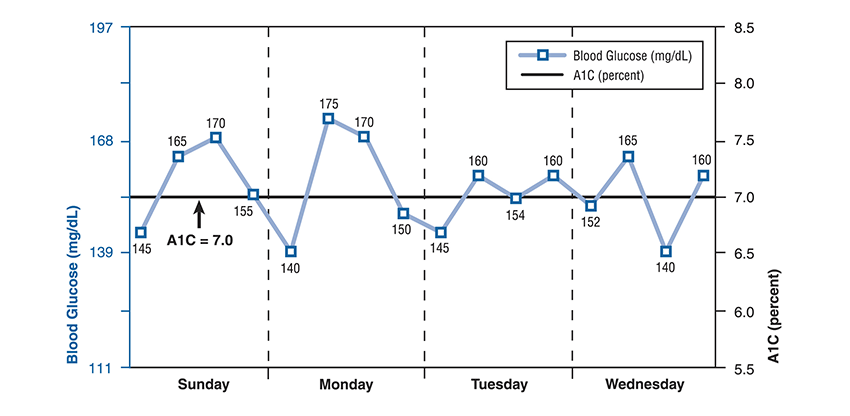
Daily blood glucose against A1C — NIDDK / NIH, US Government work — public domain.
Act 2, 'HbA1c is the average of three months'. A published chart showing every day's sugar swinging while the A1C sits as one flat line. It teaches the idea without inventing a number. source page
Waiting for clinical review
These lines are in the film but are not covered by the official guidance above.
A diabetes educator or endocrinologist has to confirm or delete each one.
Where
Claim
Why it needs review
Act 3
Vegetables and dal first, rice last, so the rise is slower.
Supported by postprandial-glucose trial literature, not by WHO or NHS guidance. Moderate evidence. Remove if the reviewer is not comfortable.
Act 3
Keep one katori of rice back when you serve.
Practical portion framing with no quantity given. Reviewer should confirm it does not read as a calorie prescription.
Act 4
Muscle is the biggest place your sugar goes.
Skeletal muscle is the principal site of post-meal glucose disposal — standard physiology, now backed by ADA §5 (resistance training improves insulin action). Wording is 'biggest place', not a number; reviewer to confirm it is not overreaching.
Act 5
Ask your doctor if your kidneys are affected before adding a lot of protein.
Referral only. No source above states it; it is standard clinical practice.
Act 6
The same-day and go-now thresholds for vomiting, breathing, sleepiness and wounds.
Composed from S1 (complications) and S3 (seek urgent care when unwell on diabetes medicine). Reviewer must confirm the thresholds for this population.
Deliberately not in the film
Any HbA1c or fasting-glucose target number — targets belong to the doctor.
Any statement about remission as an outcome for a particular person; the film says 'can go quiet' and never suggests stopping medicine.
Any glycaemic-index figure — licence barrier, and it teaches the wrong model.
Any dose, titration, or 'you can reduce your tablets'.
Any glucose or HbA1c target number — targets belong to the doctor. Activity numbers (150 min, 2 days, 2–3 days balance) are allowed: they are exercise guidance, not a glucose goal.